How Hafez al-Assad Planted Sectarianism
- info5144197
- Jan 9
- 3 min read
An Early Strategy for Control and Social Division
Sectarianism in Syria was not the result of historical coincidence, nor a spontaneous eruption of old divisions.
Under Hafez al-Assad, sectarianism in Syria was not accidental. It was a deliberate political strategy used to divide society and maintain control.
Under Hafez al-Assad, it was a carefully designed political tool, used early as a method of control, social restructuring, and fear management.
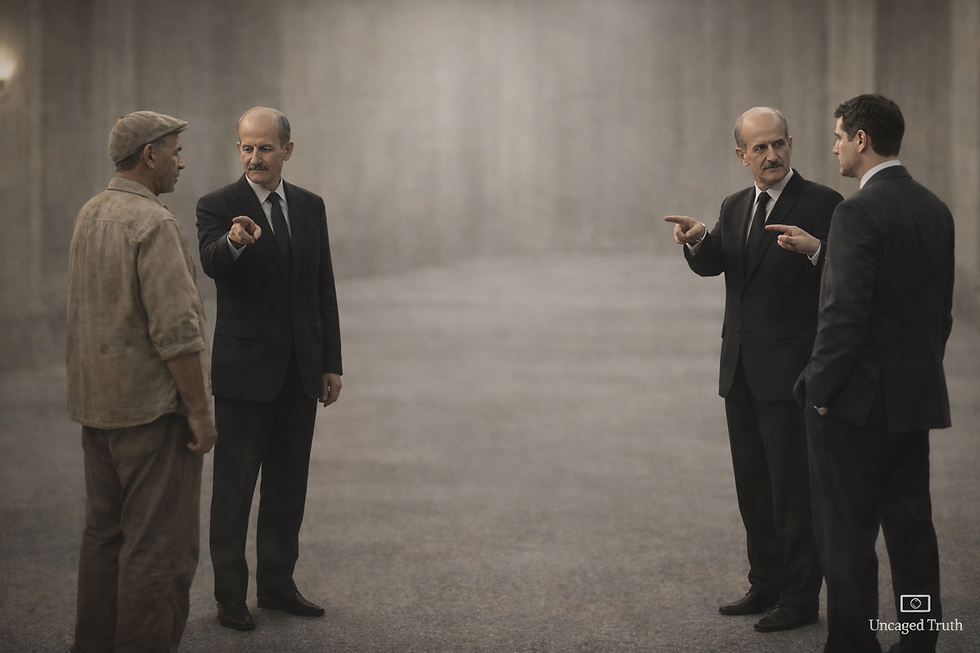
What made this strategy especially dangerous was that it was never presented as explicit sectarianism. It was introduced as a system of safety.
No religious slogans were raised, and no official policy announced division. Yet the structure that was built turned sectarianism into an unspoken daily reality.
From the moment he came to power, Hafez al-Assad understood a core truth of authoritarian rule:
A unified society is difficult to control, while a divided one is easier to dominate.
Open division, however, provokes resistance. So the division had to be planted quietly, in a way that led people to reproduce it themselves without realizing it.
The strategy began inside state institutions.
The security services and the army were not built only on loyalty to the regime, but on narrow networks of trust based on affiliation, kinship, and shared fear.
Appointments were not determined by competence alone, but by guarantees against rebellion.
In this way, the state ceased to function as a neutral entity. It became an imbalanced web of relationships.
A network in which some people felt their existence depended on the regime, while others felt the regime did not belong to them.
Sectarianism here was not a discourse. It was a feeling.
A feeling that opportunities were not equal.
That protection was not universal.
That mistakes were not judged the same way for everyone.
At the same time, any unifying national identity that could transcend these divisions was systematically dismantled.
Political parties were emptied of meaning.
Unions were subordinated.
Civil society was weakened or eliminated.
When shared public spaces disappear, people search for alternative sources of safety.
Most often, that safety is found in smaller identities: family, sect, region.
In this way, the regime did not need to impose sectarianism directly.
The environment itself pushed people toward it.
More dangerously, the regime positioned itself as the arbiter between these divisions.
It created uneven tensions and then presented itself as the guarantor of stability.
It did not prevent division. It managed it.
Each group was made to fear the other.
Each side was convinced that the fall of the regime would mean domination by the other.
Thus, fear of authoritarianism was transformed into fear of society itself.
This strategy not only destroyed trust between people. It distorted their understanding of politics, the state, and citizenship.
The citizen no longer saw the state as a protector of all, but as a party to the conflict.
The other was no longer seen as a partner, but as a competitor for safety.
Over time, sectarianism became an unspoken language.
It appeared in jokes, in hints, in caution, and in silence.
Even those who rejected it intellectually found themselves affected by it behaviorally.
Most dangerous of all, this legacy did not end with the departure of Hafez al-Assad.
Sectarianism, planted as a tool of rule, became an open social wound.
A wound that lives in memory, fear, and mistrust.
Dismantling this legacy does not happen through denial, mutual accusations, or hollow slogans of unity.
It begins with understanding how and why it was planted, and who benefits from its survival.
Sectarianism was not a Syrian destiny. It was a policy.
And policies can be dismantled, but only when they are confronted as instruments of power, not as identities.
Rebuilding Syrian society does not begin by erasing difference, but by removing it from the realm of fear.
It requires separating people from the roles imposed on them within a system of control.
When Syrians understand that sectarianism was not their protection, but their constraint,
the first real path opens toward a society not governed by fear, and not divided in order to be ruled.
Related Reading on Uncaged Truth
To explore how authoritarian systems quietly reshape ambition and behavior, read:
To understand how these same patterns appear inside organizations and companies, read:


Comments